
 Location :
The Asian-Australian monsoon system (A-AuMS) is the most typical cross-equatorial coupled monsoon system in the world. At seasonal timescale, the summer monsoon in one hemisphere is usually linked with the winter monsoon of the other hemisphere via outflows. However, whether such cross-equatorial monsoon coupling persists during orbital-scale paleoclimate evolution remains lacking in robust evidence. The scarcity of high-resolution paleoclimatic records from the monsoon region of northern Australia in the Southern Hemisphere has been a limitation in fully understanding the dynamic mechanisms of the A-AuMS.
Previous studies have attempted to compare Chinese and South American speleothem records to decipher monsoon evolution in the two hemispheres, proposing that orbital-scale low-latitude monsoon changes are primarily controlled by solar insolation. However, the South American monsoon and the Asian monsoon do not belong to the same cross-equatorial monsoon system, thus lacking direct dynamic linkages. Coupled with ongoing debates regarding the indicative significance of speleothem oxygen isotopes, this viewpoint remains uncertain.
A research team led by Prof. YAN Hong from the Institute of Earth Environment of the Chinese Academy of Sciences (IEECAS), in collaboration with scholars from Australia, reconstructed the past 13.5ka Australian summer monsoon (AuSM) changes depending on a 5.13m-long sedimentary core derived from the Bromfield Swamp in tropical monsoon region of northern Australia.
Their research found that the AuSM decreased during the early Holocene (about 11-7.8ka), a trend inconsistent with the increased summer insolation in Southern Hemisphere, implying that the low-latitude insolation change is not the sole driving factor regulating the tropical monsoon evolution.
Through the comparative analysis with paleoclimatic records from Northern Hemisphere, the team proposed that the retreat of Northern Hemisphere high-latitude ice sheets during the early Holocene weakened the East Asian winter monsoon, which in turn significantly influenced the intensity of AuSM by weakening the cross-equatorial airflow. This finding provides evidence for the cross-equatorial coupling of monsoons in the two hemispheres at the orbital timescale.
Further research reveals that the Asian and Australian summer monsoon exhibited nearly opposite variations throughout the Holocene. This coupling relationship is primarily regulated by the thermal imbalance between the two hemispheres, which could be characterized by inter-hemispheric temperature gradients. From the early to middle Holocene, the retreat of Northern Hemisphere high-latitude ice sheets may have contributed to the gradual warming of the Northern Hemisphere and the consequent decrease of south-north temperature gradient. The “thermal equator” shifted northward, which also drove the mean position of the ITCZ migrated north, strengthening the East Asian summer monsoon (EASM) and weakening the AuSM. From the middle to late Holocene, after the ice sheets had largely retreated, the increased temperature gradient may be associated with the reverse variation of summer insolation between the Southern and Northern Hemispheres, which resulted in the southward migration of the “thermal equator”, causing the ITCZ to shift south. This resulted in a weakened EASM and a strengthened AuSM.
This theory also applies to the Younger Dryas (YD) event. Integrated records showed that the Asian-Australian monsoon region also generally presented an opposite hydrological spatial pattern, with the Asian monsoon region was dry and the Australian monsoon region was wet. This is corresponded to the southward shift of the “thermal equator” (and the ITCZ) induced by Northern Hemisphere cooling due to the weakening of the Atlantic Meridional Overturning Circulation (AMOC).
This study not only provided empirical evidence for the orbital-scale coupling of monsoon changes between Northern and Southern Hemispheres, but also explicitly proposed that the thermal imbalance between two hemispheres is the primary driving force regulating the monsoon changes. Solar insolation is just one of the factors that contributing to the thermal imbalance, but not the all.
This finding, published in Nature Communications, was jointly funded by the National Natural Science Foundation of China (NSFC), the National Key R&D Program of China and the State Key Laboratory of Loess Science.
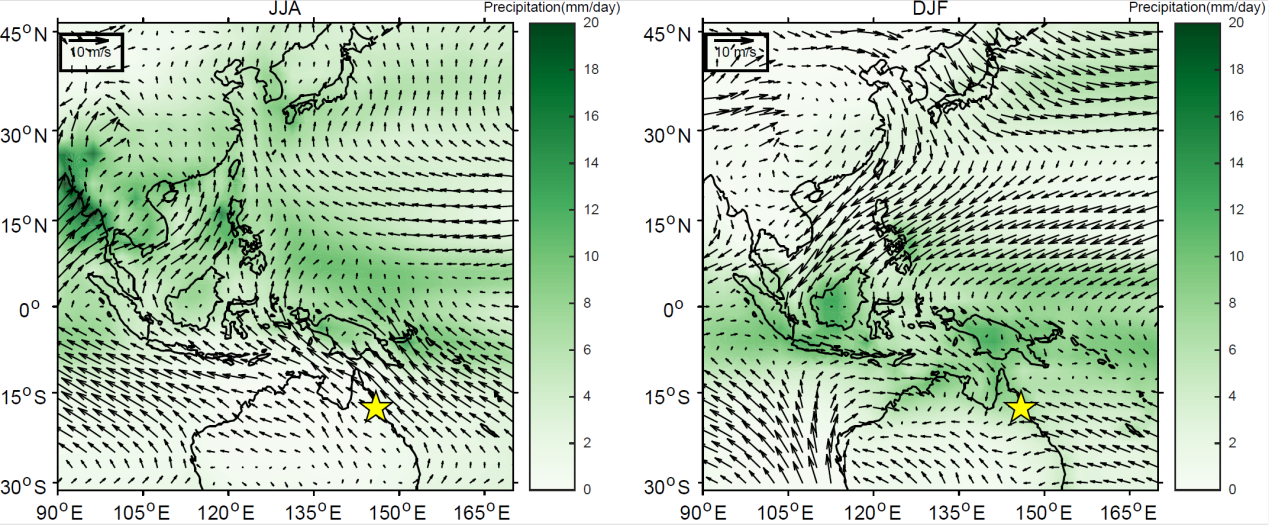
Fig. 1 850 hPa seasonal wind field and precipitation during 1979-2020 in A-AuMS region. (Image by SHI Ge, et al)
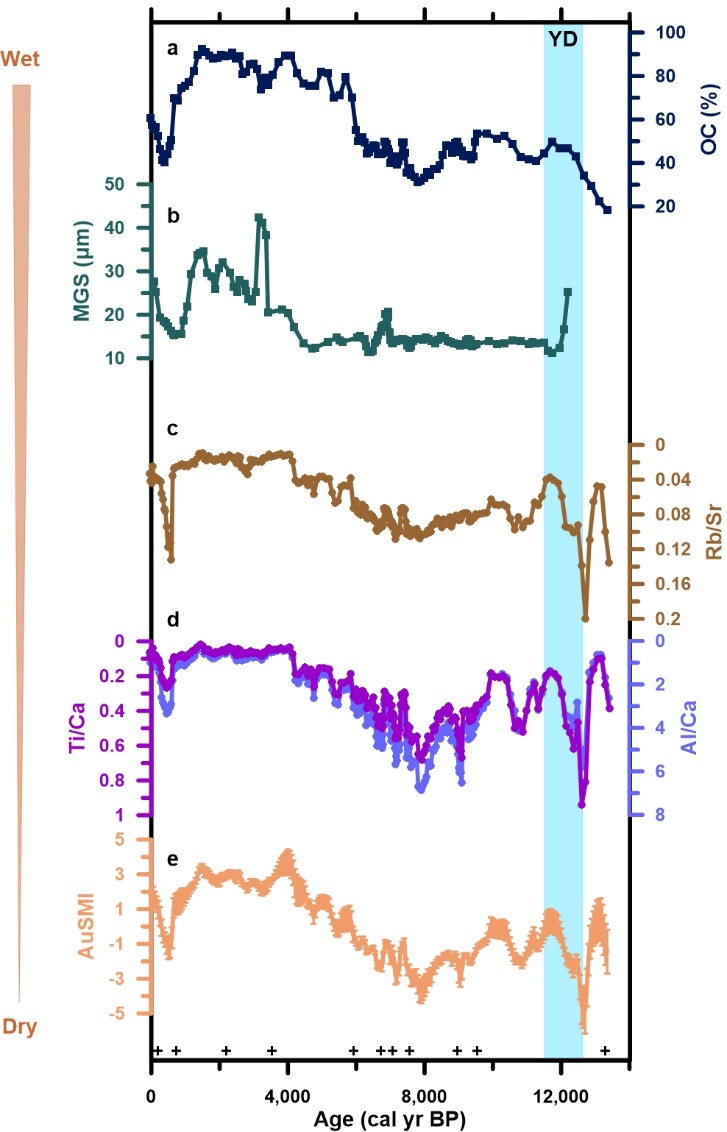
Fig. 2 Multiple hydrological proxies from the Bromfield Swamp. (Image by SHI Ge, et al)
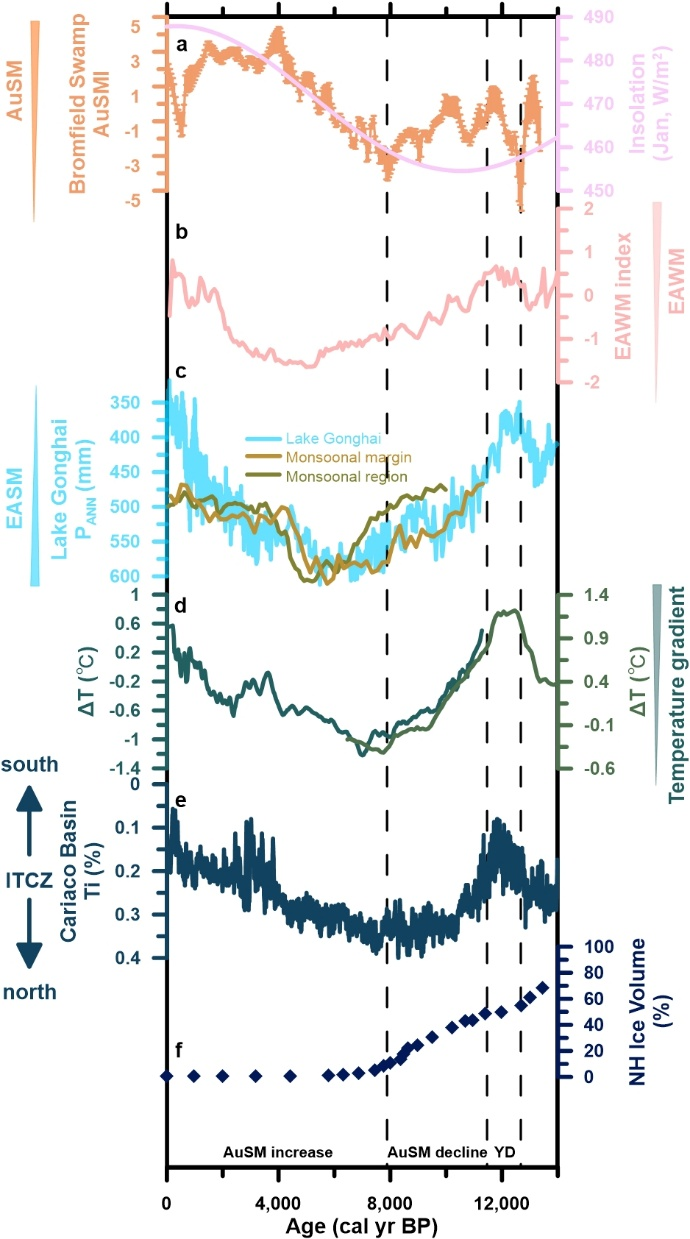
Fig. 3 Comparison of AuSM record with other paleoclimate records. (Image by SHI Ge, et al)
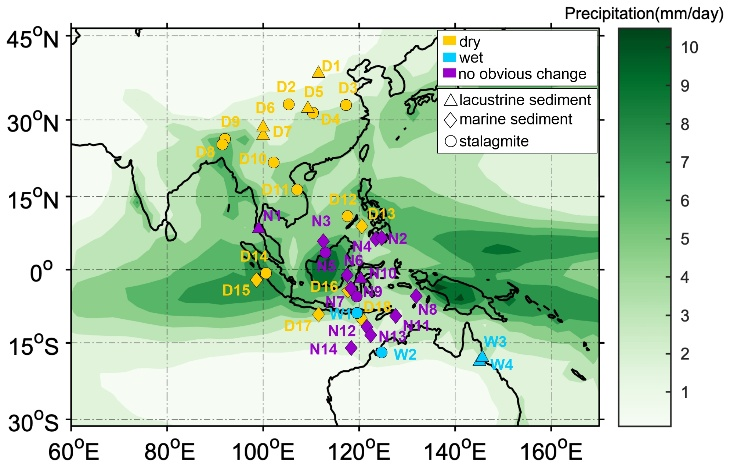
Fig.4 Distribution of hydrological records in A-AuMS region during the YD event. (Image by SHI Ge, et al)
 © 2015 Institute of Earth Environment,CAS
 Address:No. 97 Yanxiang Road, Xi'an 710061, Shaanxi, China