
 Location :
A team of researchers from China, Australia, Spain and US has revealed evidence of advanced stone tool technologies in East Asia dating back 160,000 to 72,000 years ago.
The new study was published in Nature Communications on January 27, 2026.
Led by the Chinese Academy of Sciences, an international team of researchers conducted multidisciplinary archaeological research at Xigou, located in the Danjiangkou Reservoir Region in central China, uncovering evidence of advanced stone tool technologies dating back 160,000 to 72,000 years ago. The explorations revealed hominins in this region were far more inventive and adaptable than previously believed, at a time when multiple large-brained hominins were present in China, such as Homo longi and Homo juluensis, and possibly Homo sapiens.
To determine the age of the site, multiple luminescence dating methods were applied to six samples for cross-validation. The results demonstrate that the quartz ReOSL ages provide a reliable indicator of the depositional age of the profile. Accordingly, the cultural layer within this profile has been constrained to approximately 160–72 ka, offering a well-defined chronological framework for investigating human activity during this period.
Detailed analyses of the 2601 pieces of lithics from the site show hominin inhabitants employed sophisticated stone toolmaking methods to produce small flakes and tools. Small-sized flakes were primarily produced with core reduction strategies ranging from expedient to well-organized (core-on-flake and discoid technologies). The dominant small tool retouching patterns evidence a great degree of technological standardization and complexity. Among the most striking finds was the discovery of hafted stone-tools—the earliest known evidence of composite tools in East Asia. Two different handletypes: juxtaposed and male, were documented in the traceological analysis. These tools combined stone components with handles or shafts, and demonstrated complex planning, skilled craftsmanship, and an understanding of how to enhance tool performance.
The archaeological findings at the Xigou site challenge the narrative that early humans in China remained conservative over time. The site’s rich stratigraphic sequence, spanning approximately 90,000 years, coincides with growing evidence of increasing hominin diversity in China. The presence of large-brained hominins at sites such as Xujiayao and Lingjing—sometimes classified as Homo juluensis—offers a plausible biological basis for the behavioral complexity reflected in the stone tool assemblages from Xigou.

Location of the site. (Image by YUE Jianping, et al)
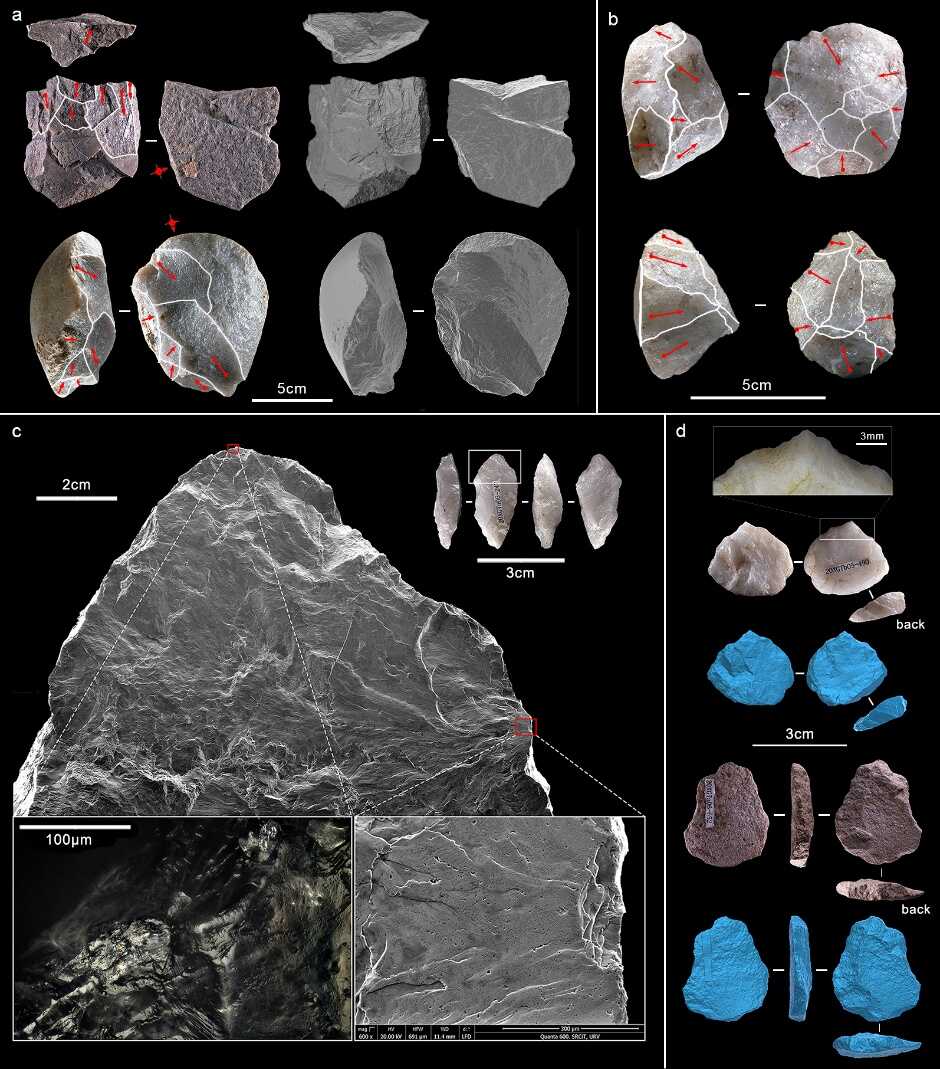
Cores and tools. (a) Core-on-flake; (b) Discoid core; (c) Tanged borer; (d) Backed borer. (Image by YUE Jianping, et al)
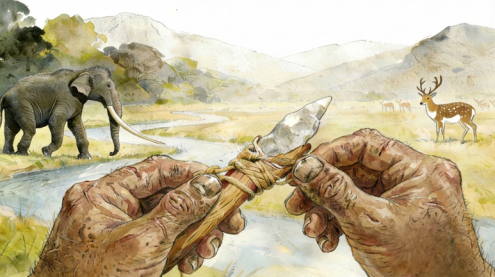
Reconstruction of Xigou tool-making (by Hulk Yuan)
 © 2015 Institute of Earth Environment,CAS
 Address:No. 97 Yanxiang Road, Xi'an 710061, Shaanxi, China