
 Location :
Water vapor (H2Ov) is an essential component of the Earth's atmosphere, playing critical roles in climate regulation, weather patterns, and the water cycle. Its sources primarily come from natural processes such as ocean evaporation and terrestrial evapotranspiration.However, during the fossil fuels (e.g., coal, petroleum, natural gas) combustion process, in addition to emitting substantial amounts of CO2, they also generate significant amounts of water vapor as a byproduct (combustion-derived water vapor sources: CDWV).
In densely populated areas, the portion of CDWV can exceed 10% in the planetary boundary layer. Enhanced atmospheric water vapor content in megacities can trigger a cascade of adverse effects, including exacerbated air pollution, weakened solar radiation, increased frequency of extreme weather events, and enhanced greenhouse effects. Consequently, accurately quantifying the contribution of CDWV to total atmospheric moisture is critical for assessing anthropogenic impacts on the hydrological cycle. The distinct isotopic signatures between natural water vapor and CDWV offer a promising solution.
The research team from the Institute of Earth Environmen of, Chinese Academy of Science (IEECAS) determined the composition characteristics of δ18Ov, δ2Hv, and d-excessv in water vapor generated from the combustion of coal, natural gas, liquefied gas, and in water vapor emitted from vehicle exhaust using online observation techniques.
The researchers find that δ18Ov produced by fossil fuel combustion inherits the isotopic signature of atmospheric O2 (23.9‰) due to its participation in combustion, resulting in significantly positive δ18Ov values and markedly negative d-excessv characteristics in CDWV. The differences in δ18Ov among fuels arise from the chemical compositions and the partitioning ratio of 18O atoms between CO2 and H2O during combustion with atmospheric O2 involvement.
Generally, the observed isotopic variation ranges of CDWV predominantly fall within the theoretical range. The CDWV can be distinguished from natural water vapor in the δ2H-δ18O space. By leveraging the distinct isotopic characteristics of CDWV—notably its significantly positive δ18Ov and markedly negative d-excessv—which differ markedly from natural water vapor, researchers integrate precisely measured CDWV isotopic compositions with local energy consumption structure.
This approach constrains the isotopic characterization of locally emitted fossil-derived water vapor, providing a critical tool for tracing urban atmospheric moisture sources, quantifying the contribution of anthropogenic water vapor to air pollution, and assessing its impacts on regional hydrological cycles.
This work, published in the Environmental Science & Technology, was jointly funded by the National Natural Science Foundation of China, the Western Light - "Western Young Scholars" project, the National Key Research and Development Program, and the Pilot Project of the State Key Laboratory of Loess Science.
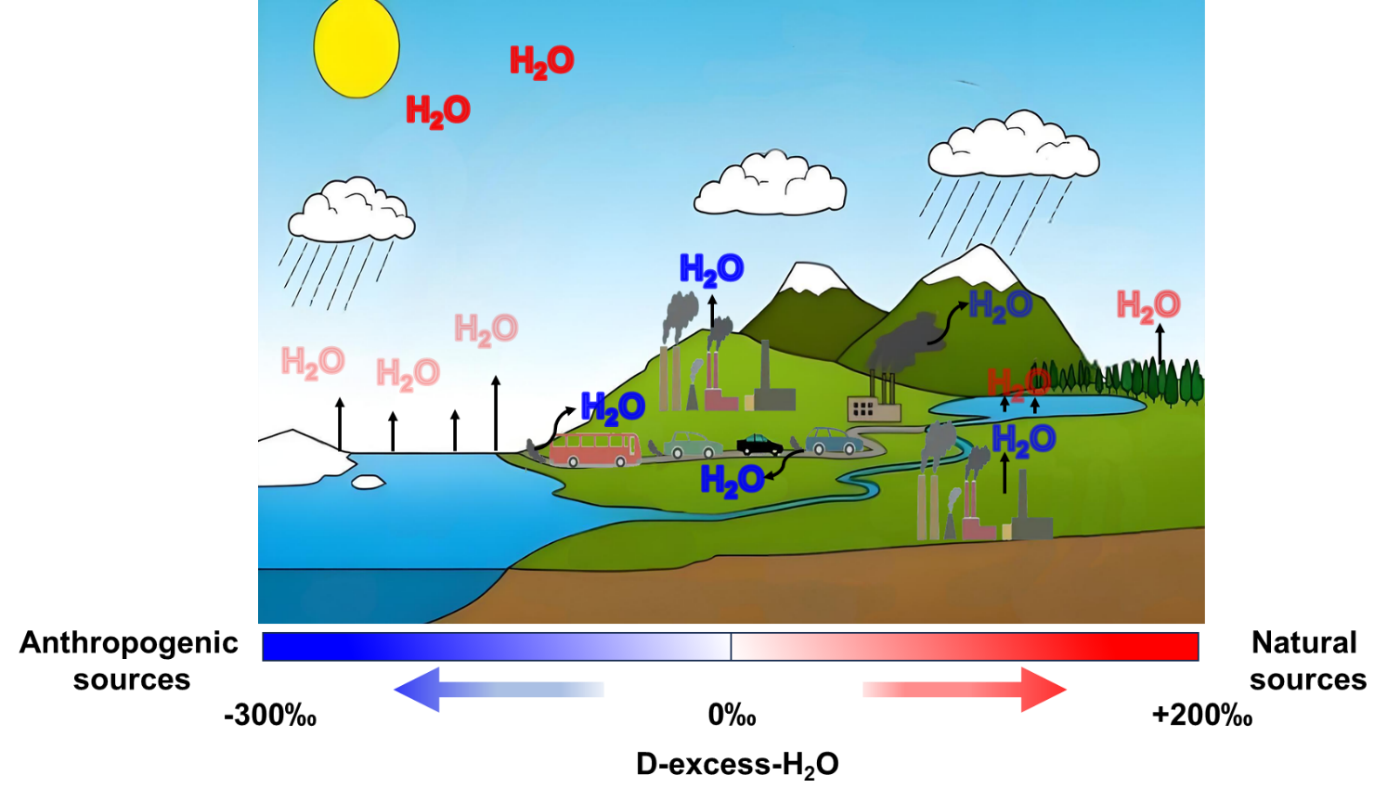
Fig. Schematic diagram showing the composition of water vapor d-excessv from anthropogenic sources and natural sources (Image by IEECAS)
 © 2015 Institute of Earth Environment,CAS
 Address:No. 97 Yanxiang Road, Xi'an 710061, Shaanxi, China