
 Location :
A study spanning 60 years and encompassing 205 countries and regions worldwide, systematically reveals the evolution patterns of nitrogen and phosphorus nutrient use efficiency for the four major staple crops—rice, wheat, maize, and soybean.
The research indicates that while global fertilizer input has continued to increase, the nutrient use efficiency of major crops has not improved correspondingly and generally remains at low levels. This highlights that "high input, low efficiency" persists as a systemic challenge confronting global agriculture.
The researchers found significant disparities in efficiency performance across different crops and regions. Rice in tropical areas and wheat in temperate zones often exhibit relatively higher NUE. In contrast, maize in major producing regions such as China and the USA shows a distinct "high input–low utilization" pattern, marking it as a key area requiring optimization focus. Notably, the phosphorus use efficiency for all four crops is generally below 50%, indicating that crop phosphorus nutrition still largely relies on the native soil phosphorus pool rather than fertilizers applied in the current season.
The research points out that the fundamental bottleneck for agricultural green transformation is not a lack of technology, but rather the spatiotemporal mismatches among crop physiological demands, environmental nutrient conditions, and human management practices. Therefore, the core of future agricultural optimization should shift from "how to fertilize" to "how to systematically restructure," aiming to redesign the underlying architecture of agroecosystems through intelligent matching of crops, climate, and soil.
Based on these findings, the study proposes a tri-level parallel systemic optimization pathway encompassing "crop–region–technology." At the crop level, targeted precision fertilization should be implemented for identified inefficient crop–climate zone combinations. At the regional level, management resources should be prioritized for "efficiency sink" areas based on spatially explicit efficiency distributions. At the technological level, measures such as high-nutrient use varieties, conservation tillage, straw return, and functional microorganism application should be integrated to form comprehensive technology packages for enhancing efficiency and reducing emissions.
The global nutrient efficiency atlas constructed in this study not only unveils the core contradiction in agricultural nutrient management but also provides a scientific framework capable of dynamically diagnosing system bottlenecks and simulating management outcomes. It offers crucial scientific underpinning for advancing global agricultural green transformation, achieving fertilizer reduction and efficiency enhancement, and promoting sustainable cropland use.
The findings are published in Nature Communications under the title "Global-scale prevalence of low nutrient use efficiency across major crops." This research was supported by projects including the National Natural Science Foundation of China, the European Union's Horizon Europe Framework Programme, and the Shaanxi Provincial Young Science and Technology Nova Project.
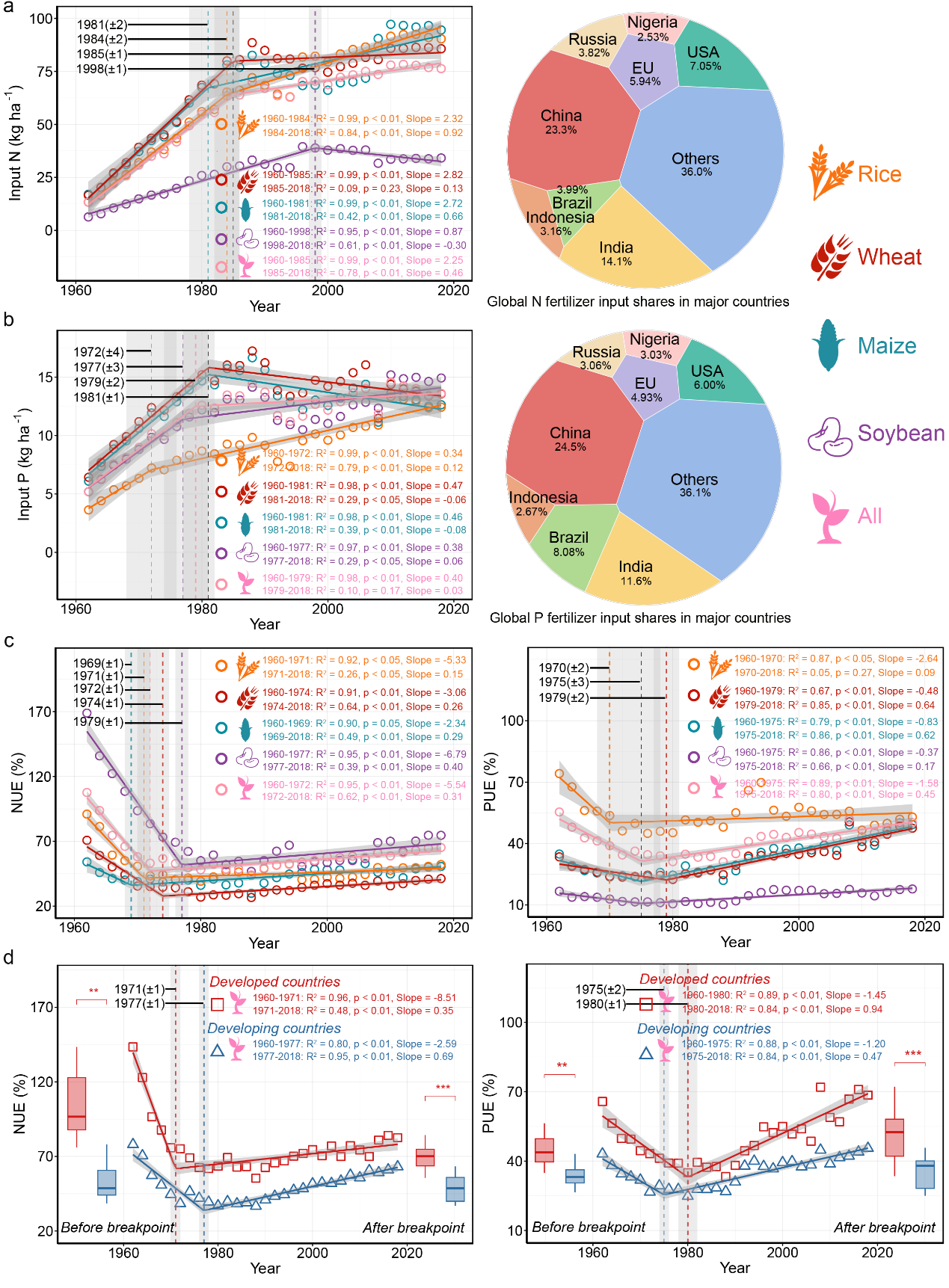
Fig. Temporal patterns of global nitrogen and phosphorus fertilizer inputs and nutrient use efficiency. (Image by LIU, et al)
 © 2015 Institute of Earth Environment,CAS
 Address:No. 97 Yanxiang Road, Xi'an 710061, Shaanxi, China